NATURAL GAS VS DIESEL STANDBY GENERATORS: WHICH IS RIGHT FOR YOU?
The fuel you choose for a standby generator affects everything that matters: how long it can run, how often you service it, what it costs to install, and even where it can sit on your property. Natural gas and diesel are the two dominant choices for whole-home and commercial backup. Here's how to pick the right one.
Natural gas standby generators
Natural gas generators tap directly into your home's utility gas line. That means effectively unlimited runtime during an outage — as long as the gas utility is delivering pressure, the generator keeps running. No fuel deliveries, no tank levels to monitor, and no fuel degradation in storage.
Gas units also burn cleaner than diesel, with lower particulate and sulfur emissions, which matters for some HOA and local air-quality rules. Installation is straightforward where gas service already exists: a licensed plumber runs a dedicated gas line from your meter to the generator pad.
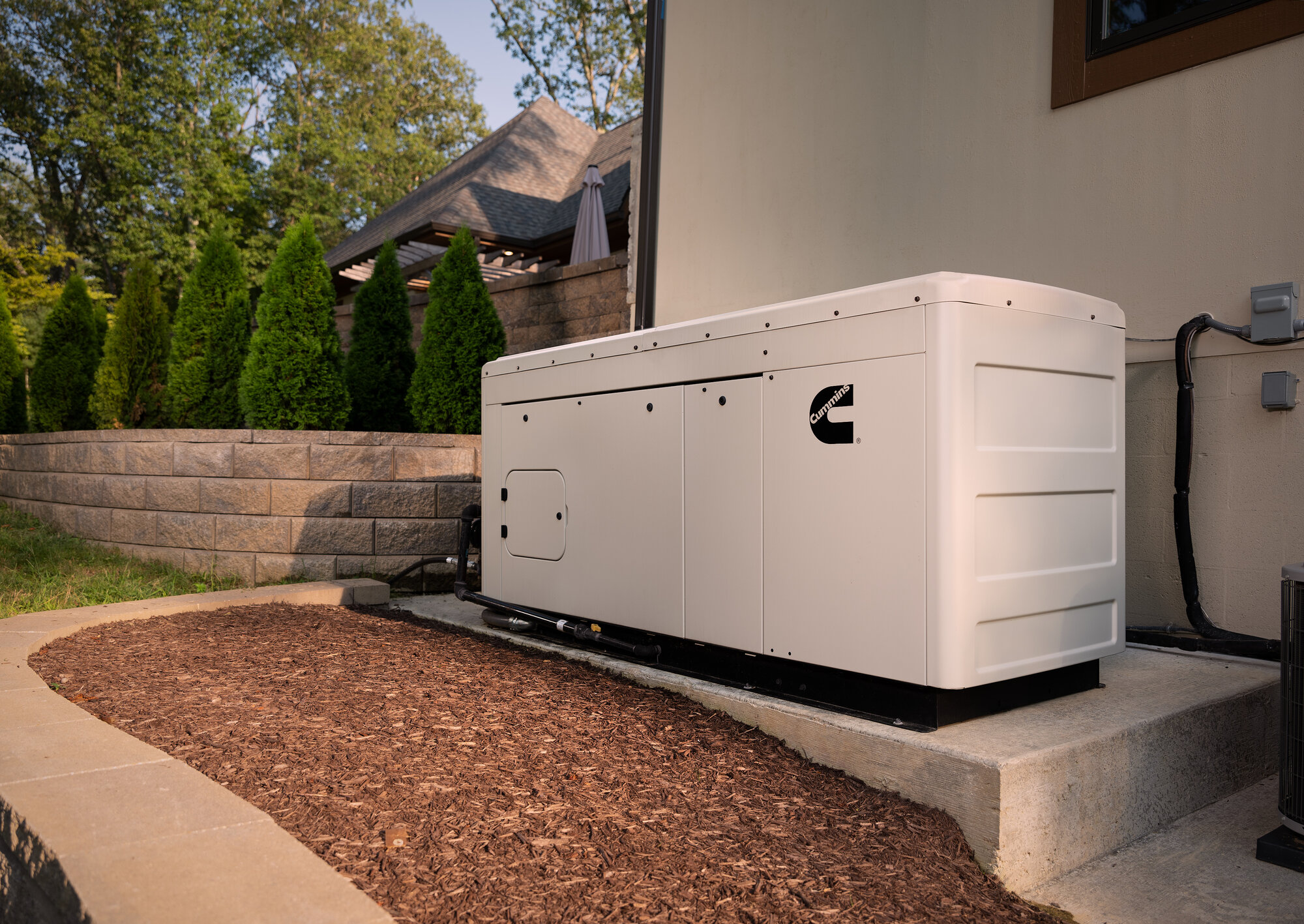
Cummins natural gas standby units break into two cooling platforms:
- Air-cooled (residential, ~13–22 kW) — Cummins models like RS13A, RS17A, RS20A (also coded as C13N6H, C17N6H, C20N6H) fit most single-family homes with one or two HVAC zones and standard gas appliances.
- Liquid-cooled (larger homes / light commercial, 25 kW+) — starting with the RS25 / C25N6 and scaling up, these handle bigger simultaneous loads, multiple HVAC systems, and longer runtimes under full demand.
You can browse natural gas standby generators or jump to all standby generators to see the full Cummins lineup.
LP / propane
Most gas standby generators are the same engine hardware configured for either natural gas or LP. If your property has no utility gas line, an on-site propane tank is the practical alternative. A buried 500–1,000 gallon LP tank is common for whole-home standby.
The trade-off is runtime limited by tank size. A 22 kW generator can burn through a 500-gallon tank in a few days of continuous heavy load, though real-world runtime is usually longer because the generator cycles with load. For rural homes without natural gas, LP is the standard path — just size the tank for your expected outage duration.
Diesel standby generators
Diesel generators offer the highest power density and fuel efficiency under sustained heavy load. They're the dominant choice for commercial buildings, data centers, large estates, agricultural operations, and any site that needs long unattended runtime without a gas line.
All diesel standby generators are liquid-cooled by design, regardless of kilowatt rating. Cummins diesel units like the C20D6 and larger C-series models run a radiator-cooled engine built for continuous-duty cycles. If you see a Cummins diesel in the 20 kW range, it is liquid-cooled — not air-cooled.
The practical considerations for diesel are:
- On-site fuel tank required — usually a sub-base or remote tank sized for your desired runtime.
- Fuel maintenance — diesel degrades and can grow algae/microbes over months. Tanks need periodic inspection, and fuel may need polishing or treatment.
- Higher noise and vibration than gas equivalents — plan pad placement and enclosure accordingly.
- Emissions regulations — some jurisdictions restrict diesel runtime or require after-treatment (DPF/SCR) for non-emergency use.
If diesel fits your project, browse our diesel standby generators or view the full shop to compare options.
Head-to-head comparison
- Runtime: Natural gas = unlimited (utility line). LP = limited by tank size. Diesel = limited by tank size, but very fuel-efficient under heavy load.
- Refueling: Natural gas = none needed. LP = tank refill by delivery truck. Diesel = tank refill by delivery truck or on-site pumping.
- Upfront cost: For similar kW, natural gas and LP units are usually close in price; diesel tends to cost more because it's always liquid-cooled and built for heavier duty.
- Maintenance: Natural gas = simplest (no fuel storage). LP = simple (clean-burning, minimal residue). Diesel = standard engine care plus fuel system maintenance.
- Emissions / noise: Natural gas = cleanest and quietest. LP = clean, slightly louder than NG. Diesel = loudest, more particulate; may need after-treatment in regulated areas.
- Best use case: Natural gas = homes with gas service. LP = rural homes without gas. Diesel = commercial, large estates, critical backup, and long unattended runtime.
Which should you choose?
Here's the practical breakdown we give customers on the phone:
- Most homes with natural gas service: Choose a natural gas standby generator. It's the simplest fuel, unlimited runtime, and the lowest long-term hassle. An air-cooled 18–22 kW unit covers most single-family homes; step to liquid-cooled 25 kW+ for larger or all-electric loads.
- Rural homes without utility gas: Choose LP (propane). The same generator engines run on LP with a field kit, and a 500+ gallon buried tank is standard. Plan for periodic refills if you expect multi-day outages.
- Commercial, critical backup, or large estates: Choose diesel if you need the highest reliability under sustained heavy load, or if no gas line is available and you need longer runtime than a propane tank can practically deliver. Diesel is also common where the site already runs diesel equipment and fueling infrastructure exists.
FAQ
- Is a natural gas or diesel generator better for a house?
- For most homes with utility gas service, natural gas is the better choice — unlimited runtime, no refueling, and lower emissions. Diesel shines for large estates, commercial sites, and rural properties without gas service that need heavy sustained load and long unattended runtime.
- Do diesel generators need more maintenance?
- Diesel generators need the same engine maintenance (oil, filters, coolant) plus fuel system care. Diesel fuel can degrade and grow microbial contamination over time, so tanks need periodic inspection and sometimes fuel polishing or treatment. Natural gas generators skip the fuel storage headache entirely.
- Can a standby generator run on both natural gas and propane?
- Most home standby gas generators are factory-built as 'dual fuel' or field-convertible between natural gas and LP. The same Cummins air-cooled units that run on utility gas can usually be configured for a propane tank. Diesel engines cannot burn natural gas or propane without extensive modification.
- How long can a natural gas generator run continuously?
- As long as the utility gas line stays pressurized — effectively days or weeks. That's the main advantage of natural gas standby over diesel or LP. The only limit is the engine's scheduled maintenance interval, not the fuel supply.
- Are diesel generators louder than natural gas?
- Diesel generators are typically louder and produce more vibration than similarly sized natural gas units, especially under load. Enclosures and distance from living spaces help, but if noise is a primary concern and gas is available, natural gas or LP tends to be the quieter option.
Not sure where to start?
Run our free 60-second sizing calculator or talk to a generator pro for a no-pressure quote.